
.svg)
You need creators. Not five. Not twenty. Hundreds — maybe thousands — posting about your products every week.
That's the math of TikTok Shop in 2026. Physician's Choice generated $2.4M in 28 days — powered by a creator network of 2,000+ affiliates built over two years. MySmile scaled past $1M/month within three months using a micro-creator army. Love & Pebble hit 1,194% growth with a 3.2x ROAS by combining creator affiliates with Shop Ads.
The brands winning on TikTok Shop aren't running one-off influencer campaigns. They're building always-on creator networks that produce content daily. And the ones who figure out recruitment at scale will own their categories for years. (The broader social commerce trends in 2026 confirm this — TikTok Shop's 4.7% conversion rate is more than double any competing platform.)
This guide covers exactly how to do it — from finding your first 10 creators to managing 2,000+.
Why Creator Recruitment Is the #1 Growth Lever on TikTok Shop
TikTok Shop runs on creator content. Your product listing alone won't generate meaningful sales — the algorithm surfaces videos, not product pages. Every sale starts with a creator making content that stops someone's scroll.
The data backs this up:
- 78% of TikTok shoppers discover products through creator content
- 58% of users make purchases directly through the app
- TikTok nano-influencers (1K-10K followers) deliver 20.64% average engagement rates — significantly higher than Instagram's 3-5% average
- TikTok Shop conversion rates range 5-12% once a viewer clicks a product link — with top-performing sellers at the high end (vs. 2-4% in traditional e-commerce)
But here's the uncomfortable truth: The industry pattern: roughly 80% of your creators will underperform while 20% drive almost all your GMV. That's the power law of creator commerce. Your job isn't just to recruit — it's to recruit efficiently, identify the 20% fast, and build systems that scale.
The 4 Creator Discovery Methods

Method 1: TikTok's Native Discovery Tools
Start here. It's free, it's official, and it surfaces creators already opted into TikTok Shop.
Find Creators (Seller Center) — Built directly into your TikTok Seller Center under the Affiliate tab. Search by niche, follower count, engagement rate, and location. Filter by past shop performance and GMV generated. The limitation: it only shows creators who've already opted into TikTok Shop's affiliate program.
TikTok Creator Marketplace (TTCM) — Richer data than Seller Center — audience demographics, content performance history, brand safety scores. Useful for Target Collaborations where you're inviting specific creators. The matching is more sophisticated, but the pool is smaller.
TikTok One — TikTok's newer platform combining creator discovery with campaign management. AI-powered matching based on brand fit. Integrated with the ads ecosystem so you can go from discovery to Spark Ads in one workflow.
Best for: Your first 10-30 creators. Manual, high-touch, but the data is trustworthy because it comes from TikTok directly.
Method 2: Third-Party Discovery Platforms
When you need to scale past what TikTok's native tools can handle, third-party platforms become essential.
Cruva has the largest TikTok-specific creator database (3M+ verified TikTok Shop affiliates) with the ability to send 3,000+ outreach messages per day across TikTok and email. Their AI handles auto-replies, which becomes critical at volume.
Euka AI automates the affiliate engine — 1,000 DMs per day plus 2,500 targeted invitations daily. Useful for brands that need pure volume.
Kalodata doesn't do outreach, but it's the best tool for reverse-engineering competitor creator partnerships. See which creators are promoting competing products, their performance data, and GMV generated. Use this intelligence to poach (ethically — by offering genuinely better terms).
FastMoss provides similar competitor intelligence with a focus on creator discovery and partnership tracking.
Modash has the broadest database at 250M+ influencers across all platforms. It's not TikTok Shop-specific, but it's useful for identifying creators who have strong TikTok presences but haven't entered the TikTok Shop ecosystem yet.
SFN AI takes a fundamentally different approach. Instead of just matching based on follower counts and engagement rates, SFN AI analyzes a creator's Content DNA — their natural style, strengths, format preferences extracted from their last 50+ videos. This enables matching creators to products based on content fit, not just audience size. When the match is based on how a creator actually creates, the resulting content converts at dramatically higher rates.
Best for: Scaling from 30 to 300+ creators. The outreach automation and data depth justify the investment.
Method 3: Manual Discovery (Hashtag Mining + Competitor Poaching)
Don't underestimate manual methods. They're slower but often surface the best creators — the ones tool databases haven't indexed yet.
Hashtag Mining: Search TikTok for niche hashtags — #tiktokmademebuyit, #tiktokshopfinds, or your category-specific tags. Filter by recent videos that include shopping tags. Check engagement rates and read the comments (comment quality tells you more about purchase intent than like counts). Look for creators already promoting similar products who aren't yet in your program.
Competitor Creator Poaching: Use Kalodata or FastMoss to identify which creators promote competitor products. Cross-reference their performance data. If a creator is generating solid GMV for a competitor at 12% commission, reaching out with 18% plus free samples is a compelling offer. The ethics here are straightforward — you're offering a better deal, not stealing. Creators promote multiple brands.
Comment Section Mining: Check comments on viral product videos in your category. Creators often comment asking about products or expressing interest in collaboration. Engaged commenters with creator accounts are warm leads who've already self-identified as interested.
Best for: Finding hidden gems. The creators you discover manually often become your best performers because the match was intentional, not algorithmic.
Method 4: Inbound Creator Attraction
The method most brands ignore: make creators come to you.
Set up Open Collaboration on your best-selling SKUs with a competitive commission (12-15% minimum) — our affiliate campaign setup guide walks through every step. Enable auto-approve for the first 30 days. Ship free samples to every creator who applies. This turns your product listing into a creator recruitment engine — they discover you while browsing TikTok Shop's affiliate marketplace.
The best brands combine inbound (Open Collaboration) with outbound (active recruitment). Open catches organic interest. Target Collaboration rewards the performers you identify.
Outreach Strategy: From DM to First Video

The Numbers You Need to Know
Cold outreach conversion in creator recruitment runs about 1-2%. That means you'll need to contact roughly 2,000 creators to land 200 active affiliates. Plan your resources accordingly.
Outreach Channels (Ranked by Effectiveness)
- In-app TikTok invitation (via Seller Center Target Collaboration) — Highest acceptance rate because it's official and creators see it in their affiliate dashboard
- TikTok DMs — Personal, native, but rate-limited without tools like Cruva or Euka
- Email — Scalable and professional, lower response rates but allows longer pitches
- Instagram DMs — Secondary channel, useful for multi-platform creators
What Actually Works in an Outreach Message
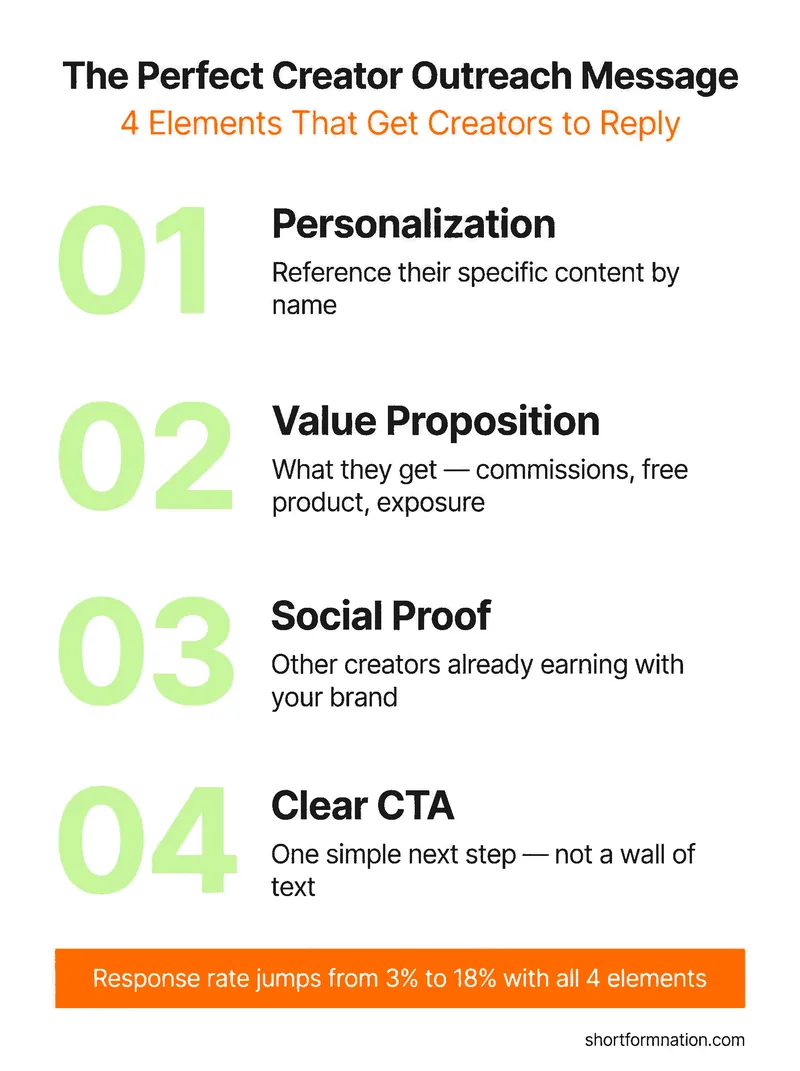
Every effective outreach message includes four elements:
Specificity. Reference something specific about their content. "Love your skincare routine videos" is generic. "Your 60-second before-and-after format on the CeraVe cleanser — that structure would work perfectly for our product" is specific.
The offer. Commission rate, free samples, and what makes your program different. Don't bury the numbers.
Social proof. "Our top creators earn $X/month" or "We work with 200+ creators in [category]." Creators want to join programs that already work.
Low friction next step. Don't ask for a meeting. Ask if they want a free sample shipped this week. Remove every barrier between "interested" and "signed up."
Here's a template that converts:
Hey [Name] — your [specific content format] on [specific product/topic] is exactly the style that performs for our brand. We're offering [X%] commission on [product] + free samples shipped to you this week. Our top creators are earning $[range]/month. Want us to send a sample?
Sample Seeding: The Non-Negotiable
Creators perform dramatically better with product in hand. This isn't optional — it's the highest-ROI investment in your recruitment process.
Week 1 plan: Send 20-30 samples to your first batch of interested creators. Budget $500-$2,000 for product cost plus shipping.
Packaging matters: Include a branded insert card with commission details, a QR code linking to your affiliate signup, and a personal note from your team. First impressions set the tone for the relationship.
Follow-up timing: Check in 3-5 days after delivery confirmation. Don't wait for them to post — nudge with content ideas and hook suggestions. Creators who receive specific direction alongside samples are significantly more likely to post quickly.
The ROI on product seeding is typically 5-10x. A $15 product plus $5 shipping that generates a video producing $500 in sales is a 25x return.
For the complete breakdown of product seeding economics — post rate benchmarks, cost per post analysis, gifted vs paid content performance, and the seeding-to-affiliate pipeline — see: Product Seeding for TikTok Shop: The ROI of Free Samples in 2026.
The Scaling Playbook: 10 → 100 → 1,000+ Creators
Phase 1: Foundation (Week 1-4) — 10 to 30 Creators
This is the manual, high-touch phase. You're learning what works before you automate.
- Use TikTok's native Find Creators tool and manual hashtag mining
- Personally reach out to 50-100 creators via DM and Target Collaboration invitations
- Ship samples to every interested creator immediately
- Set Open Collaboration at 12-15% (see our creator payment models guide for structuring these rates)
- Enable auto-approve to maximize inbound volume
- Track everything manually: who applied, who posted, what performed
Your goal here isn't scale — it's signal. You're identifying which creator profiles, content formats, and product angles convert. This data informs everything you do next.
Phase 2: Systematize (Month 2-3) — 30 to 300 Creators
Now you layer in tools and semi-automated workflows.
- Add Cruva or Euka for outreach volume (1,000-3,000 messages per day)
- Use Kalodata to reverse-engineer competitor creator partnerships and recruit proven performers
- Set up Target Collaborations at 18-22% for every creator who generates 3+ sales — our payment models guide covers when to move from commission-only to hybrid structures
- Create templated creator briefs with hook suggestions and product talking points
- Build a simple tracking system (spreadsheet or CRM) for pipeline management
- Establish a weekly recruitment cadence: 50-100 new outreach messages per day
The shift: You're no longer doing everything yourself. Tools handle discovery and outreach volume. You focus on creator selection quality and relationship management for top performers.
Phase 3: Scale (Month 4+) — 300 to 2,000+ Creators
This is where traditional models break. A human creator manager caps out at 30-50 active creator relationships. Beyond that, you're not managing — you're triaging.
The solution is intelligence-driven management:
Automated content briefing. Instead of manually creating briefs for each creator, use a system that generates personalized content ideas based on what's working in your category right now. SFN AI's intelligence engine does this automatically — analyzing thousands of TikTok Shop videos daily, identifying patterns that drive sales, and delivering 2-3 personalized Content Ideas to each creator every morning. No manual briefing required.
Coherence scoring. At scale, you can't watch every video. You need a system that automatically evaluates whether creators are following the brief and executing the winning pattern. Low coherence scores get flagged for coaching; high coherence creators get rewarded with better commission tiers.
Alert-based management. Replace "review every video" with "respond to what matters." Brand safety violations, negative sentiment, low coherence scores, posting droughts — these get surfaced. Everything else runs without you.
Automated commission tiering. Creators who hit performance milestones automatically unlock higher commission rates. This creates a self-reinforcing loop: better performance → better rates → more motivation → better content. Our payment models breakdown details exactly how to structure retainer vs commission vs hybrid tiers.
One person can manage hundreds of creators with the right intelligence layer. Not by working harder, but by working differently — setting creative direction while the system executes at scale.
What Breaks at Scale (And How to Fix It)
10 → 100 Creators: Communication Breaks Down
You can't personally manage every creator via DM anymore. Messages get missed. Briefs don't reach everyone. Some creators go silent and you don't notice for weeks.
Fix: Move to systematic communication. Creator portal or dashboard for centralized briefs. Batch messaging for promotions and new angle distribution. Discord community for creator engagement and peer learning.
100 → 500 Creators: Content Quality Dilutes
More creators means more low-quality content. Your average coherence score drops. Some creators are posting off-brand content that could create brand safety issues.
Fix: Content intelligence. Instead of generic briefs, deliver personalized content ideas matched to each creator's proven style. Implement coherence scoring to catch quality issues before they compound. Build tiered commission structures that reward quality, not just volume.
The traditional creator management model caps at 30-50 creators per manager. AI-powered tools like SFN AI lift this to hundreds by automating the intelligence work — pattern mining, brief generation, coherence scoring, coaching prompts — so human managers can focus on strategy and relationship-building.
500 → 2,000+ Creators: Logistics Overwhelm
Sample shipping becomes a warehouse operation. Commission tracking gets complex. Dispute resolution multiplies. Creator onboarding takes weeks instead of days.
Fix: Full automation of sample fulfillment (integrate with your 3PL or FBT). Self-serve creator onboarding flows. Automated commission tracking and payout through TikTok Seller Center. Dedicated operations person or team.
The 80/20 reality at scale: 20% of creators will drive 80% of your GMV. Build systems to identify the 20% fast (coherence scores + GMV data), retain them with premium commission and exclusive access, and continuously recruit to replace underperformers in the long tail.
Creator Evaluation Framework
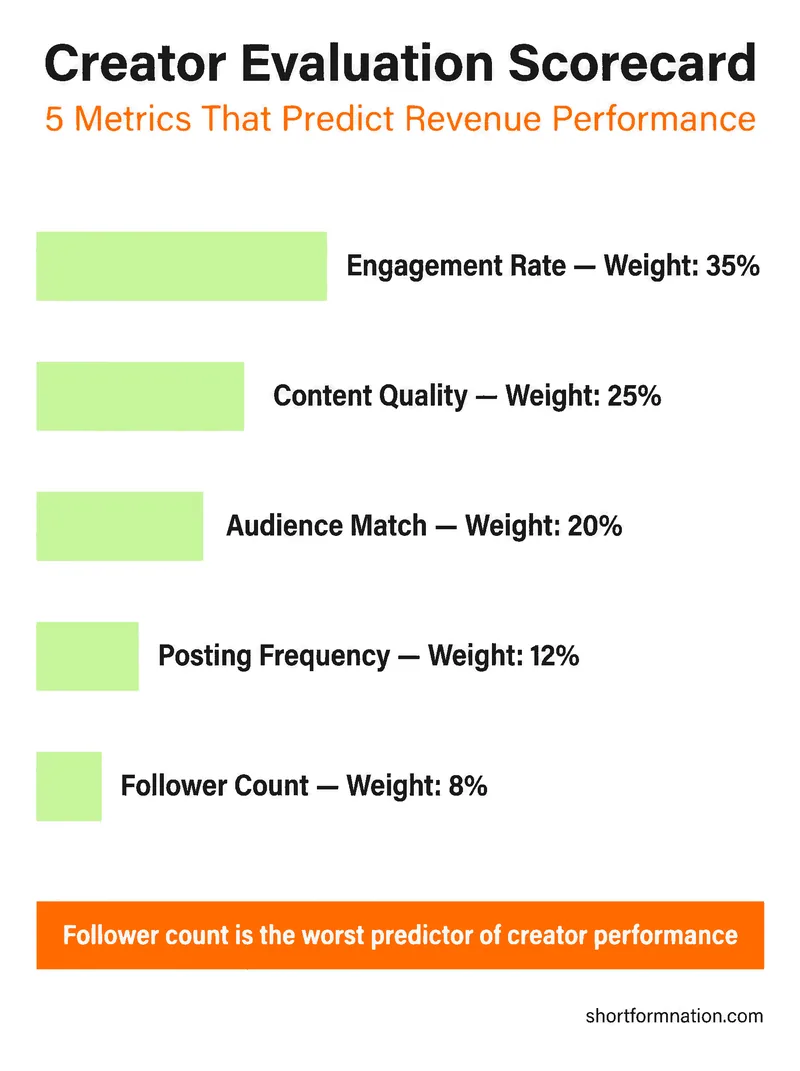
Must-Hit Thresholds
MetricMinimumSweet SpotFollowers5,000 (US requirement)10K-500KEngagement rate3%+5%+Recent TikTok Shop salesAny10+ in last 30 daysContent frequency2x/week5+/weekNiche relevanceAdjacentDirect match
Red Flags to Screen For
- Engagement rate below 1% — Likely fake or purchased followers
- No TikTok Shop content in last 30 days — They're not active in commerce
- Promotes 20+ brands simultaneously — Diluted loyalty, audience fatigue
- Negative comments about products they promote — Trust issues with their audience
- History of brand safety violations — Not worth the risk at any commission rate
Beyond Metrics: Content DNA
Traditional recruitment evaluates creators on audience metrics — followers, engagement, demographics. This misses the most important factor: how the creator actually creates.
A creator's Content DNA — their natural style, hook preferences, storytelling patterns, format strengths — determines whether they can execute a winning pattern or not. A creator with 500K followers who's great at vlogs but terrible at product demos won't convert for you, regardless of their engagement rate.
SFN AI analyzes Content DNA from a creator's last 50+ videos, enabling matching based on creative compatibility. When a creator gets an idea that fits how they naturally create, execution is effortless and coherence is high. High coherence correlates directly with higher GMV — SFN AI's data shows that creators with 90%+ coherence scores earn 6.9x more per video.
Agency vs. In-House: Which Model Fits?
Agency Model
Agencies like Viral Nation, Goat Agency, and The Influencer Marketing Factory have existing creator relationships and managed processes. They can get you 20-30 active creators fast.
Trade-offs: Agency fees run 15-30% on top of creator costs. Creator loyalty is to the agency, not your brand. Less direct control over strategy and messaging.
Best for: Brands with no internal creator management capability and budget to pay premium for speed.
In-House Model
You own the relationships, the data, and the strategy. Lower long-term costs. Full control.
Trade-offs: Requires a dedicated team member (or at minimum, dedicated weekly hours). Slower initial ramp. Tool investment needed.
Best for: Brands planning a long-term TikTok Shop presence with 50+ creators.
Hybrid (Recommended)
Use an agency for your initial 20-30 creator partnerships while learning what works. Build in-house capability with intelligence tools for scaling. Keep the agency for top-tier influencer relationships only — the creators with 500K+ followers who require managed negotiations.
Most brands operating at 200+ creators have moved to this hybrid model. The agency handles the high-touch relationships at the top; in-house teams manage the long tail with tools.
The Measurement Framework
Track these metrics weekly to evaluate your recruitment engine:
Pipeline Metrics: Outreach messages sent per week, response rate (target: 5-10%), sample requests / acceptance rate, time from first contact to first video posted.
Performance Metrics: Active creators posting per week, average videos per creator per week (target: 2-3+), GMV per creator (monthly), creator retention rate (month over month).
Quality Metrics: Average coherence score across roster, top 20% creator identification (who are they, what makes them different), content format distribution (are creators using proven patterns?).
For the complete breakdown of which metrics matter most and how to avoid the measurement mistakes that kill most programs, see our guide to TikTok Shop affiliate analytics.
Quick-Start Checklist
If you're starting from zero, here's your first 14 days:
Day 1-3: Set up Open Collaboration on your top 3-5 SKUs at 12-15% commission. Enable auto-approve for creator applications. Ship samples to the first 10 creators who apply.
Day 4-7: Search TikTok for 50 creators in your niche using native Find Creators tool. Send Target Collaboration invitations to the top 20. Begin hashtag mining for hidden gems.
Day 8-10: Follow up with all creators who received samples. Send content ideas and hook suggestions to anyone who hasn't posted yet. Review first videos and identify what's working.
Day 11-14: Evaluate first results: which creators converted sales? Which content formats performed? Set up Target Collaborations at 18-22% for top performers. Plan next week's outreach volume (scale to 50-100 messages per day). Consider adding a discovery tool (Cruva, Kalodata, or SFN AI) for the next phase.
As you scale your creator network, understanding how TikTok Shop's affiliate model compares to traditional programs matters. Our TikTok Shop affiliate vs Amazon Associates comparison breaks down where DTC brands win on each platform — and how to run both effectively.
The Bottom Line
TikTok Shop creator recruitment in 2026 isn't about finding influencers. It's about building a scalable system that continuously discovers, recruits, equips, and retains creators who produce content that drives sales.
The brands that treat this as a one-time campaign will get one-time results. The brands that build recruitment infrastructure — discovery tools, outreach automation, content intelligence, performance tracking — will compound their advantage every month.
Start with 10 creators. Learn what works. Systematize the process. Then scale with intelligence.
The window to build this advantage is open. Most TikTok Shop-native competitors haven't started. The brands that move first will own their categories.
SFN AI is the intelligence layer for TikTok Shop creator programs. We analyze what's selling, package it into proven content frameworks, and deliver personalized ideas to every creator — automatically, every day. Learn more →
Last Updated: March 2026